
Building a brand new house is exciting, until the question arises: ‘How much wire do you require? Guesswork like ‘let’s purchase an extra roll’ can be an unnecessary expense that could end up cabling the neighbour’s house too! A proper house wiring material estimate helps calculate the right cable quantity, sizes, and cost while ensuring the wiring matches your home’s actual electrical load.
Why Cable Estimation Should Happen Before Purchasing
Once the electrical layout is ready, prepare a cable estimate including the number of rooms, electrical points, appliances, cable sizes, wiring routes, and installation method. This helps you rule out two problems:
- Buying too much cable
- Discovering midway through the project that you haven’t ordered enough wire.
Both are serious; one wastes your money; the other wastes time.
What Determines the Cost of House Wiring Cables?
The house wiring cable cost calculator depends on factors such as house size, number of rooms and electrical points, appliance load, cable size and type, installation method, and brand and quality. So, calculating the electrical wire cost for house wiring isn’t as simple as multiplying the floor area by a fixed rate; the actual electrical requirements matter.
How Much Electrical Wire Does a House Need?
Depends on the requirements. The size of the house has nothing to do with cable requirements; it’s the number of lights, sockets, appliances, and their locations that determine cable requirements.
The electrical layout and the circuit design determine the wire required for house wiring. For a more precise electrical wire estimate for house, calculate the cable for each circuit, then add a reasonable allowance for routing, bends, vertical runs, and connections.
Step-by-Step Method to Estimate Cable Quantity
Here’s a simple way to calculate how much electrical cable you need.
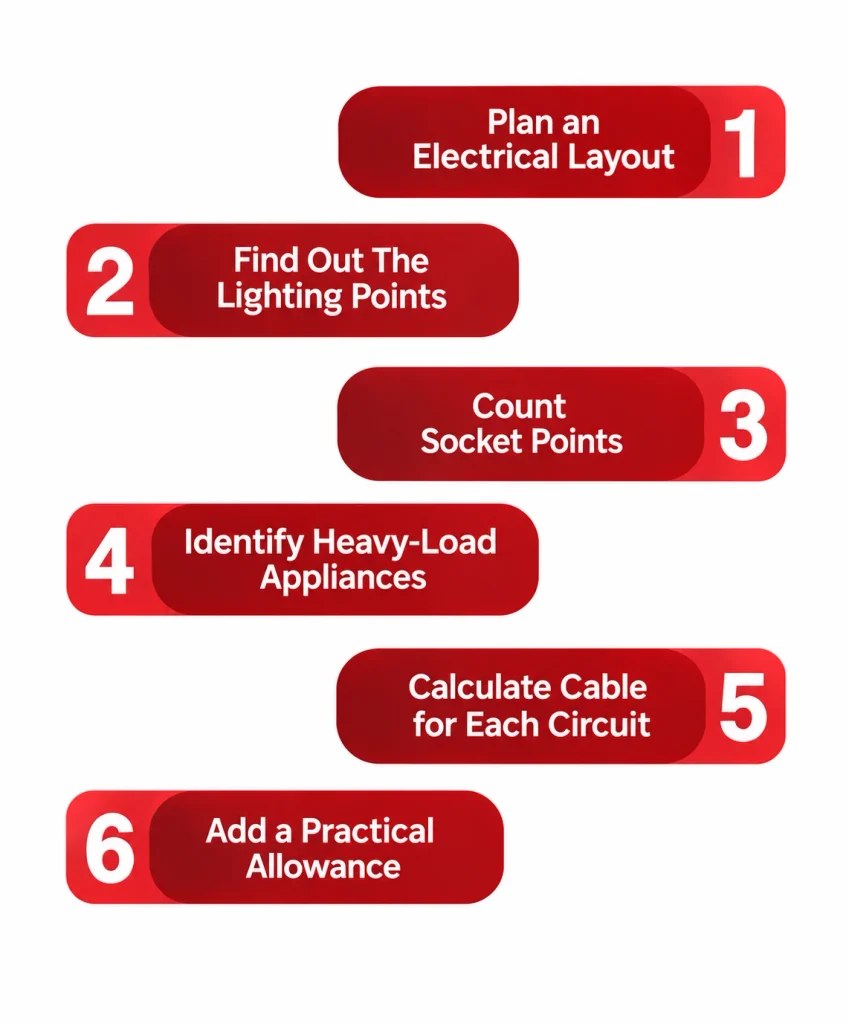
1. Plan an Electrical Layout
Start by identifying the electrical points for fans, lights, systems, appliances, switches, and sockets, and prepare an electrical plan accordingly.
2. Find Out The Lighting Points
Take the count of lighting points; accordingly, calculate the cable length from the distribution board to each light point.
3. Count Socket Points
The cable size varies with circuit load; hence, dedicated socket points designed for high-power appliances may be counted separately from the standard ones.
4. Identify Heavy-Load Appliances
Water pumps, refrigerators, air conditioners, washing machines, geysers, induction cooktops, electric ovens, etc are power-intensive appliances; ensure the relevant cable size matches their circuit.
5. Calculate Cable for Each Circuit
Approximate the distance for each circuit; multiply it by the number of conductors, include both horizontal and vertical runs, and then calculate cable for each circuit.
6. Add a Practical Allowance
Sometimes wiring is required beyond the expected route, such as around bends, structures, terminations, etc; in that situation, add an extra allowance.
Common Cable Sizes Used in House Wiring
Domestic cable sizes cover 1.5 sq. mm, 2.5 sq. mm, 4 sq. mm, and 6 sq. mm; larger sizes are used where the calculated load justifies it. Though light points and other small circuits may have smaller conductors, socket and dedicated appliance circuits may require larger ones. What matters really is that the cable selection should handle the voltage drop, expected load, installation environment, and relevant merits.
Simple House Wiring Cable Cost Formula
The house wiring cable cost is based on the required electrical cable quantity calculation at the appropriate rate per metre.
Example: Estimating Cable Cost for a 3 BHK towards:
- Light points, fans, and associated circuits
- All sockets
- AC circuits
- Geyser circuits
- Oven, induction, refrigerator, washing machine, etc
- DB from main panel
- Earth conductor- as required by design
Assume that the electrical layout and circuit design require 1,000 meters of cable in various sizes. If the weighted average price is X per metre, then the approximate cost of cable would be: 1,000 x X = 1,000X.
In practice, calculate each cable size separately because the price differs with size and length.
7 Mistakes That Increase House Wiring Costs
- Buying cable before preparing the electrical layout.
- Using the same cable size everywhere.
- Ignoring high-load appliances.
- Underestimating cable routes and vertical runs.
- Buying cheap, poor-quality cable.
- Failing to account for wastage and termination requirements.
- Changing the electrical layout after cable installation has started.
Good planning is considerably cheaper than fixing mistakes later.
How to Reduce Cable Costs Without Compromising Safety
Cost reduction doesn’t mean buying the cheapest cable available.
Rather:
- Plan circuits long before you start installing them.
- Avoid extending the cables unnecessarily.
- Do load-based calculations while choosing cable size.
- Clump electrical points.
- Do away with unnecessary wastage.
- Use reliable, certified cables.
- Have a qualified electrical professional check quantities and specifications.
The goal isn’t less cable at any cost. It’s the right cable, in the right quantity, for the right application.
Get the Right Cable Estimate for Your Home
A good electrical house wiring material estimate can save money before you even pull the first cable through a conduit. If you’re planning a new house wiring project, contact Vilvex Cables for your cable requirements and quotation. Preparing an estimate in advance helps you plan the right cable quantities and specifications for the project.
FAQs
- How do I calculate cable quantity for a house?
Make an analytical study of the electrical layout; understand the load and installation environment; count the number of points for lighting, fans, sockets, and dedicated appliances; determine the cable route and the conductors required for each circuit; add an appropriate allowance for routing and wastage, and finally calculate the cable quantity.
- How is house wiring cable cost calculated?
Calculate the required cable quantity, and multiply it by the appropriate rate per metre to get the estimated cable cost.
- How can I reduce house wiring costs?
Cost-cutting on house wiring can be done effectively provided the electrical layout is planned carefully; cable requirements, load, size, etc. are estimated accurately; wastage is minimised; and the selected cables meet the required standards and specifications.