
There is a common incident that every electrician faces, where cable wires are bunched inside a conduit and refuse to pull through or where a conduit that is barely a third full leaves space and money wasted.
Both a simplified reference of how conduit size lines up with these incidents and one single overlooked question lead to the following: How many cables should actually go inside an electrical wiring conduit pipe?
Conduit pipes give a secured layer to cable wires and ensure no demolition in the rewiring process. In this sense, understanding how much room your electrical cable wires actually need and how much a conduit pipe can manage the size of cables is an important matter. In this blog, we are breaking down the major point of house wiring conduit in securing a safe and reliable environment.
What is a Conduit Pipe & Its Purpose?
A conduit pipe is a protective tube, mostly PVC conduit pipe, that is used in house wiring, inside walls and ceilings. These pipes keep the cable protected from moisture or any physical damages, which ensures rewiring without breaking the wall.
The purpose of electric conduit pipes is to organise electrical wiring into a manageable system. With the help of a well-managed conduit layout, a technician can add cables in the future by simply pulling them through the existing pipe. In this context, there will be no need for breaking the wall.
The Importance of Conduit Fill
Conduit fill refers to the overall percentage of a conduit’s internal space which is occupied by the electrical cables. This is a significant factor which often leads to major consequences.
If you overfill conduits, it will make cable pulling difficult. In this context, cables will be tightly packed, and this will generate heat when electricity is passed. Over time, this often leads to wear and raises the risk of faults.
If you underfill conduit, there will be inefficiency in cable handling and potential loss for the paid conduit pipe capacity.
Factors that Determine How Many Cables Fit Inside a Conduit
Here are the variables that decide how many cables can be shared or added in one conduit pipe:
- Conduit diameter: larger and wider pipes hold more cables, and it is based on the cross-sectional area rather than just the width.
- Cable size: wires with 1.5sq. mm for lighting take less room than a 4 sq. mm cable.
- Conduit class: different wiring needs different conduit pipes, for example, light-duty conduit pipes for surface wiring, medium-duty for concealed walls, and heavy-duty for slab installations.
Number of bends in the run: if you choose more bends for lower fill, it keeps the electrical cable installation practical and secured.
A Quick Glance: Conduit Pipe vs. Cable Capacity
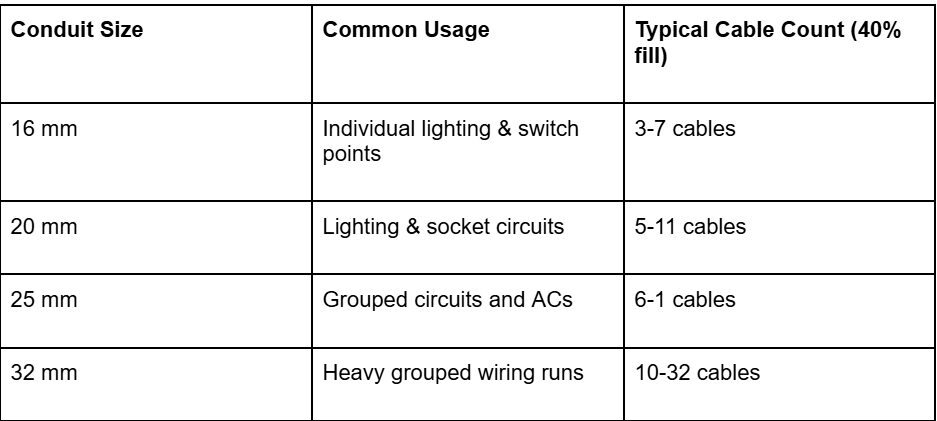
There is a general rule on the conduit pipes’ standardised installation practice: there shouldn’t be more than 40% of a conduit’s internal cross-sectional area when there are three or more cables running.
Below is the simplified reference of how conduit size lines up with the usage and cable count at the 40% fill limit.

How to Calculate Conduit Fill
The filling of conduit pipes follows three simple steps:
- Identification of the Conduit Class
Internal areas and different wall thickness require different conduit classes, from surface, concealment, and slabs.
- Identification of the Cable Size
Lighting points use thinner cables, and ACs need thicker gauge cables.
- Checking the Fill Limit
Always make sure to have a proper calculation of the combined cross-sectional area of all cables, including insulation. Then confirm the electrical conduit sizing stays within the 40% guidelines.
Common Mistakes to Avoid
There will be errors in cable conduit installation. The most frequent errors include the following:
- Choosing the conduit size based on the cable count alone.
- Filling conduit right up to the maximum limit.
- Ignoring the number of bends in a run.
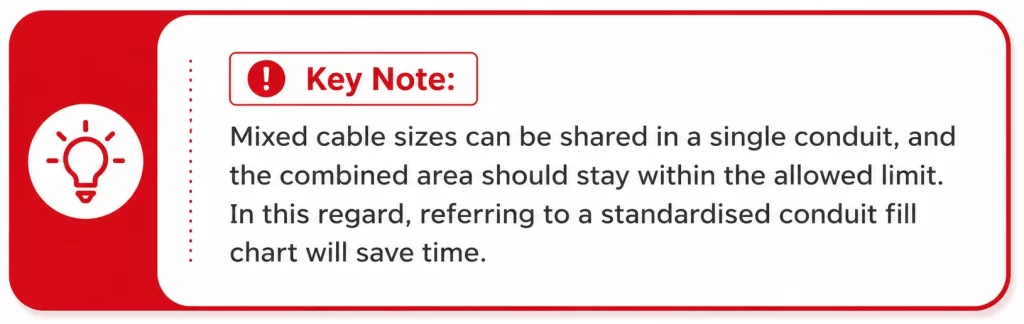
- Mixing cable without checking the combined area.
- Using a lower grade of conduit class.
For securing conduit pipe cable capacity, avoiding these errors before will offer durability.
FAQs
This is dependent on the conduit pipe’s cable capacity, size, class, and the gauge of cables used. It is important to note that cables should never occupy more than 40% of the conduit’s internal area and should run all cables together.
The conduit fill rule is the total cross-sectional area of all cables inside a conduit. This includes insulation and not exceeding 40% of the conduit’s internal area. This conduit fill limit rule keeps cables pulling manageable and secure.
For homes, medium-duty PVC conduits work well for wall wiring, and heavy-duty conduits are better for slab installations. The right choice is dependent on the type of circuits you install.